
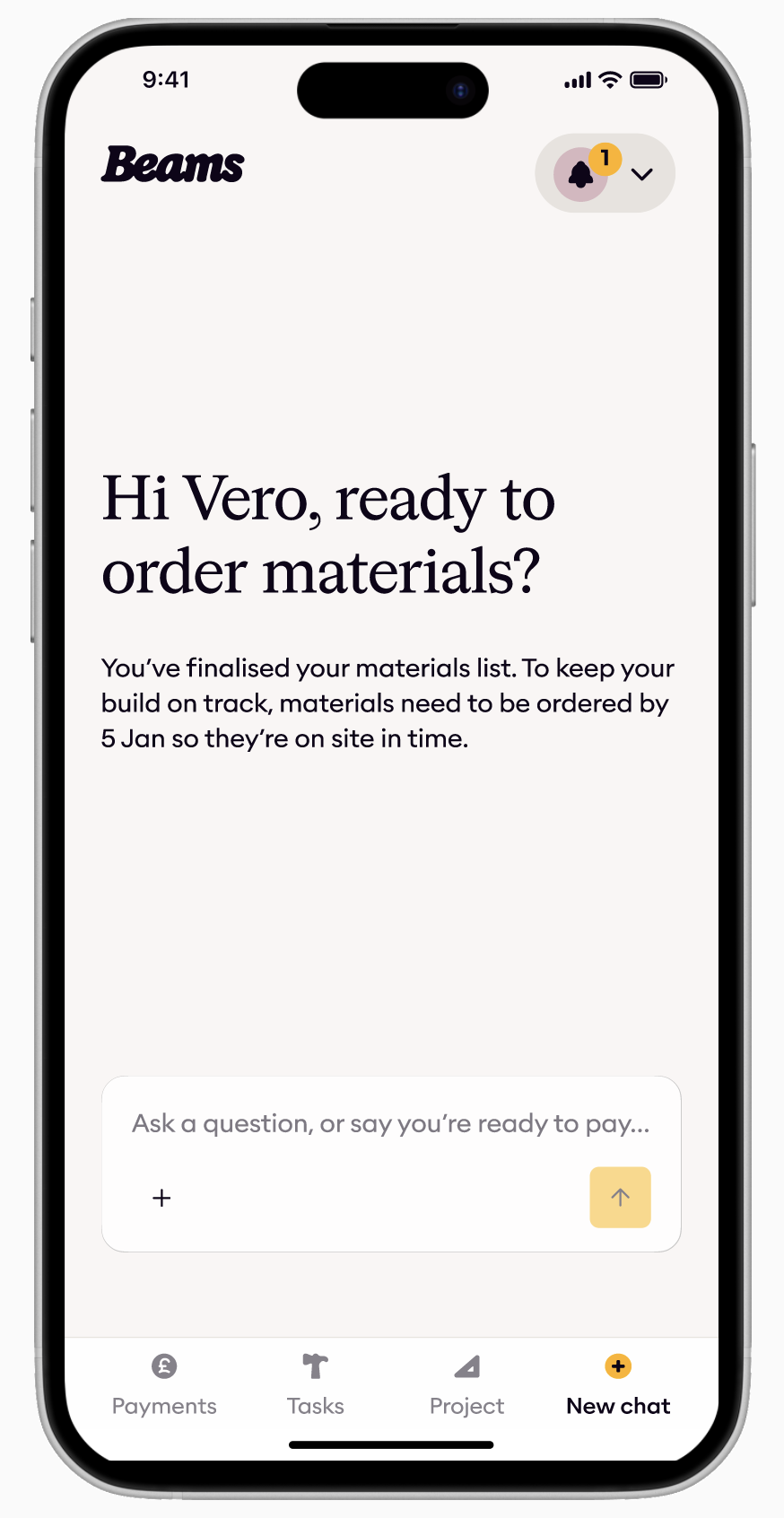
Beams: AI-led, chat-first transformation
Role: Founding Product Designer
Company: Beams Renovation
Year: Present
Impact: Lead-to-order conversion: +50% | Time-to-Value: 99% faster (30 days → 3 minutes)
I led the end-to-end design and delivery of Beams’ AI-powered renovation journey, from concept to live product. I partnered with product to define the problem space grounded in research and data, and aligned stakeholders around a new vision and focused strategy. I reshaped internal workflows to work effectively with AI, working closely with engineers to improve speed and quality of delivery. The result was a full replatform designed and shipped in three months, increasing lead-to-order conversion by 50%.
Overview
Beams’ mission was to make home renovations simple. We achieved that, but it wasn’t scalable.
When I joined Beams, the core customer platform had been inherited from an early partner. It worked, but it was rigid. Even small changes took weeks, which slowed learning and limited improvement.
That rigidity made the journey slow and operationally heavy. Customers wanted early signals on cost and feasibility. Instead, quotes depended on planner calls and manual steps, often taking around 30 days.
By then, 73% of customers had dropped out without ever seeing a price.
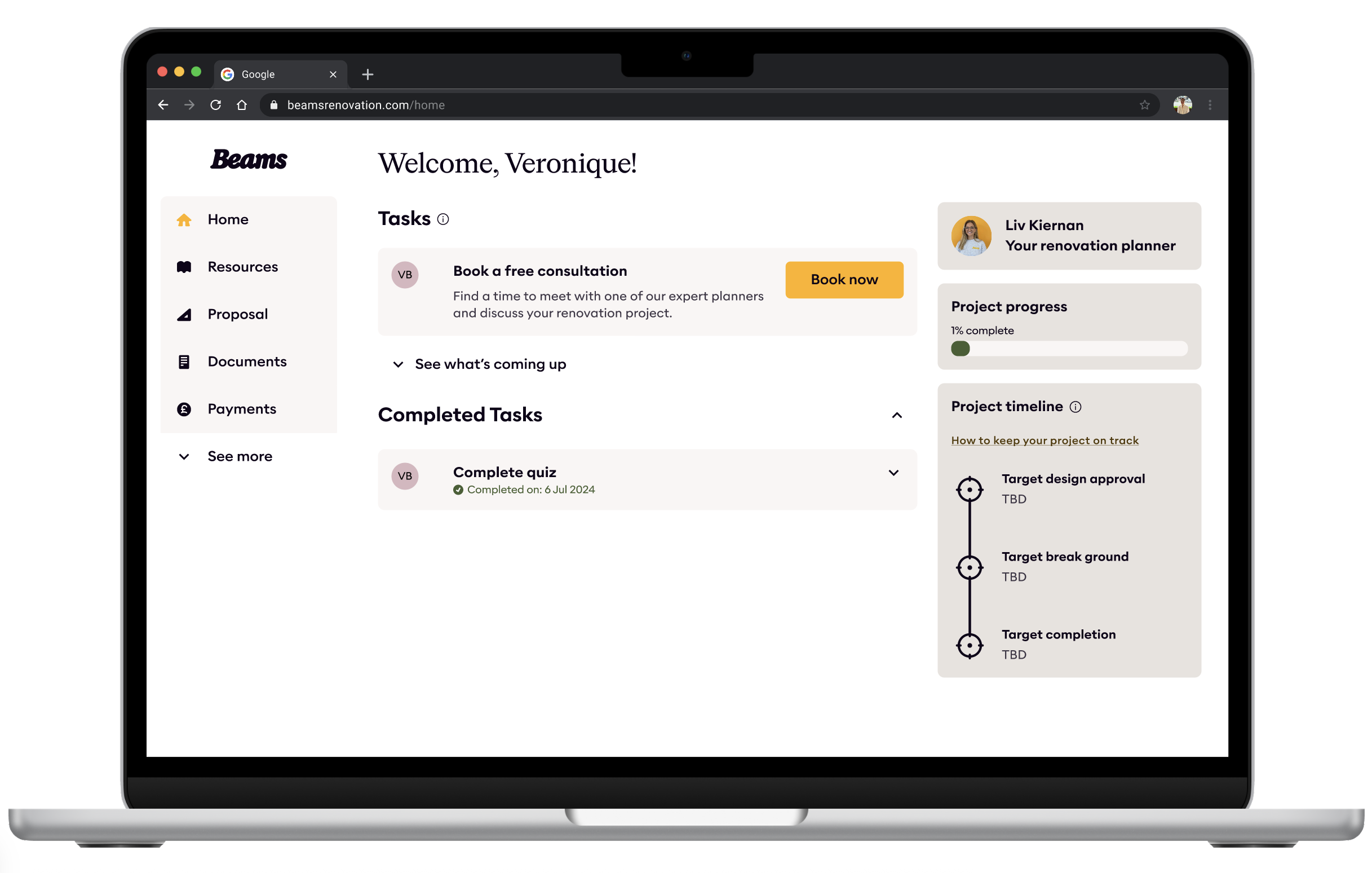
Legacy platform
Research and insight
Problem
Early-stage drop-off was a major issue.
Evidence
80% never spoke to a human.
73% dropped out before a quote.
Budget drove ~30% of losses across all project sizes.
Insight
Interviews revealed three consistent patterns:
Customers wanted to explore privately before talking to sales.
Budget confidence mattered across the majority of our ICPs, not just price-sensitive ones.
Slow, vague early experiences killed momentum and trust.
Core issue
We didn’t answer the right questions early.
Budget clarity was the biggest pain point for customers and cut across 75% of our ICPs. On average, it took us 30 days to provide it. That was far too slow, hurt conversion, and relied on an operational bottleneck that didn’t scale.
Focus
We focused on giving high-intent customers early cost confidence. We were losing them due to lack of speed and clarity, not lack of demand. There was significant opportunity in the pipeline, and cost confidence was the biggest lever to convert it.
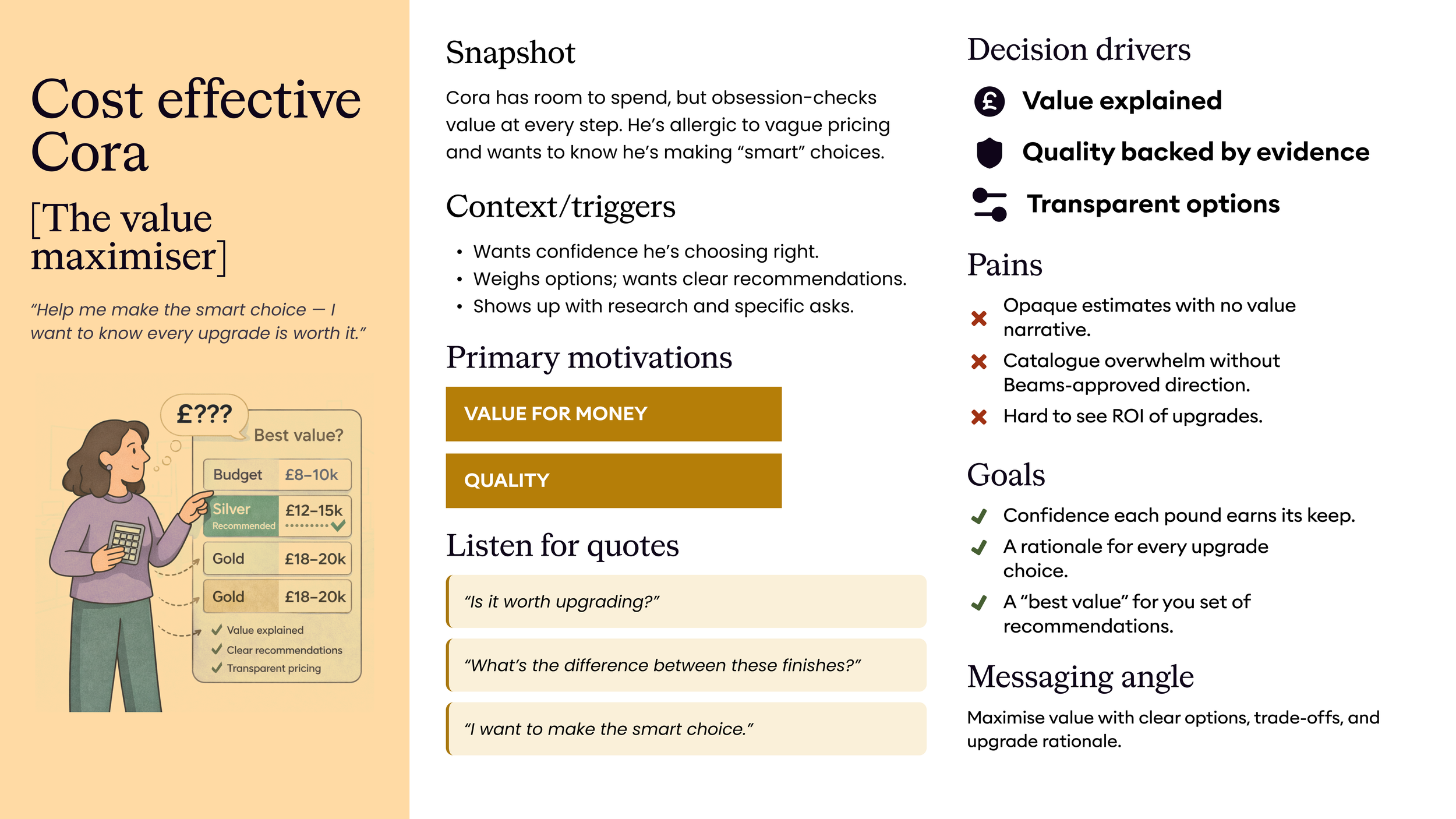
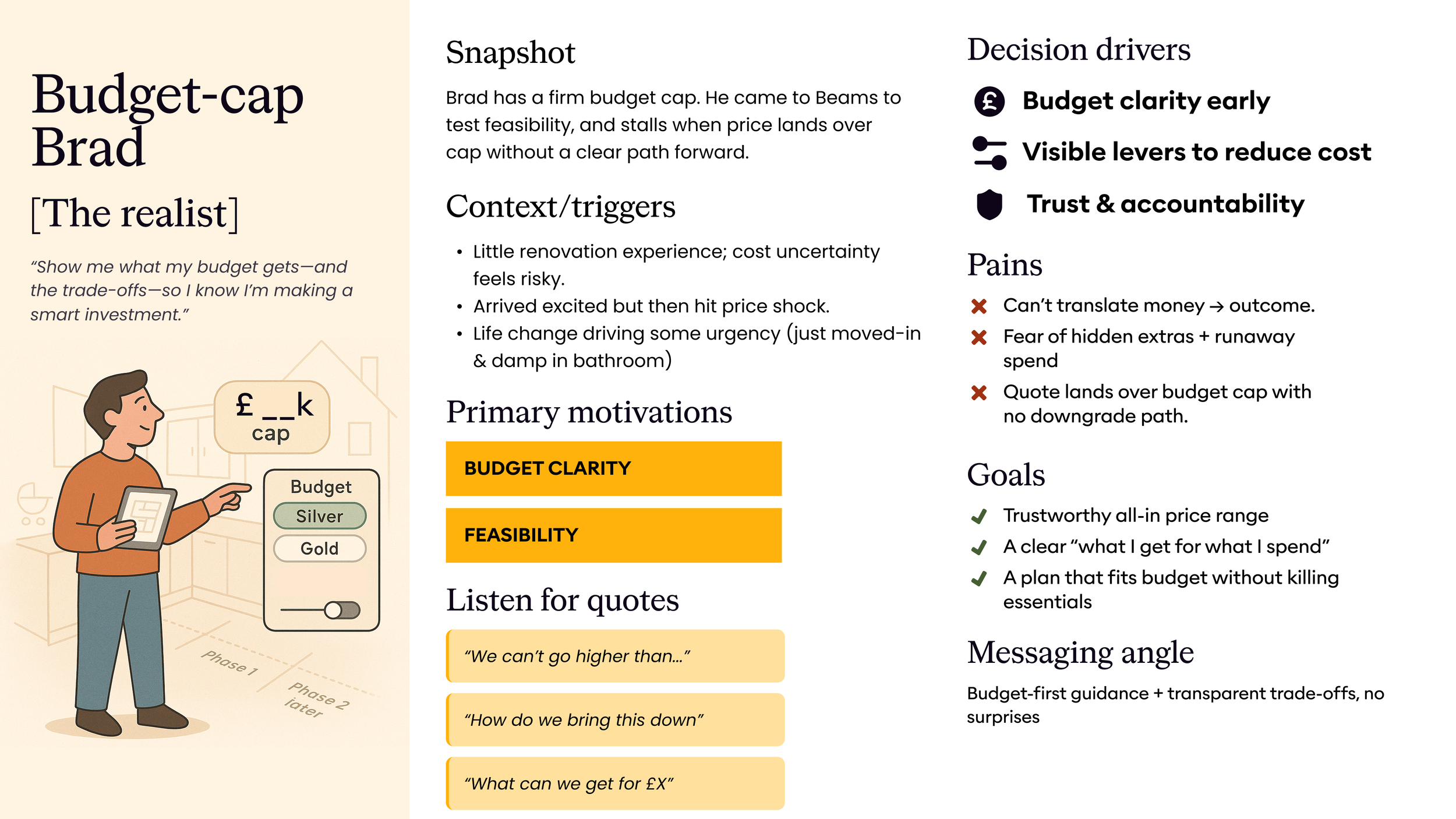
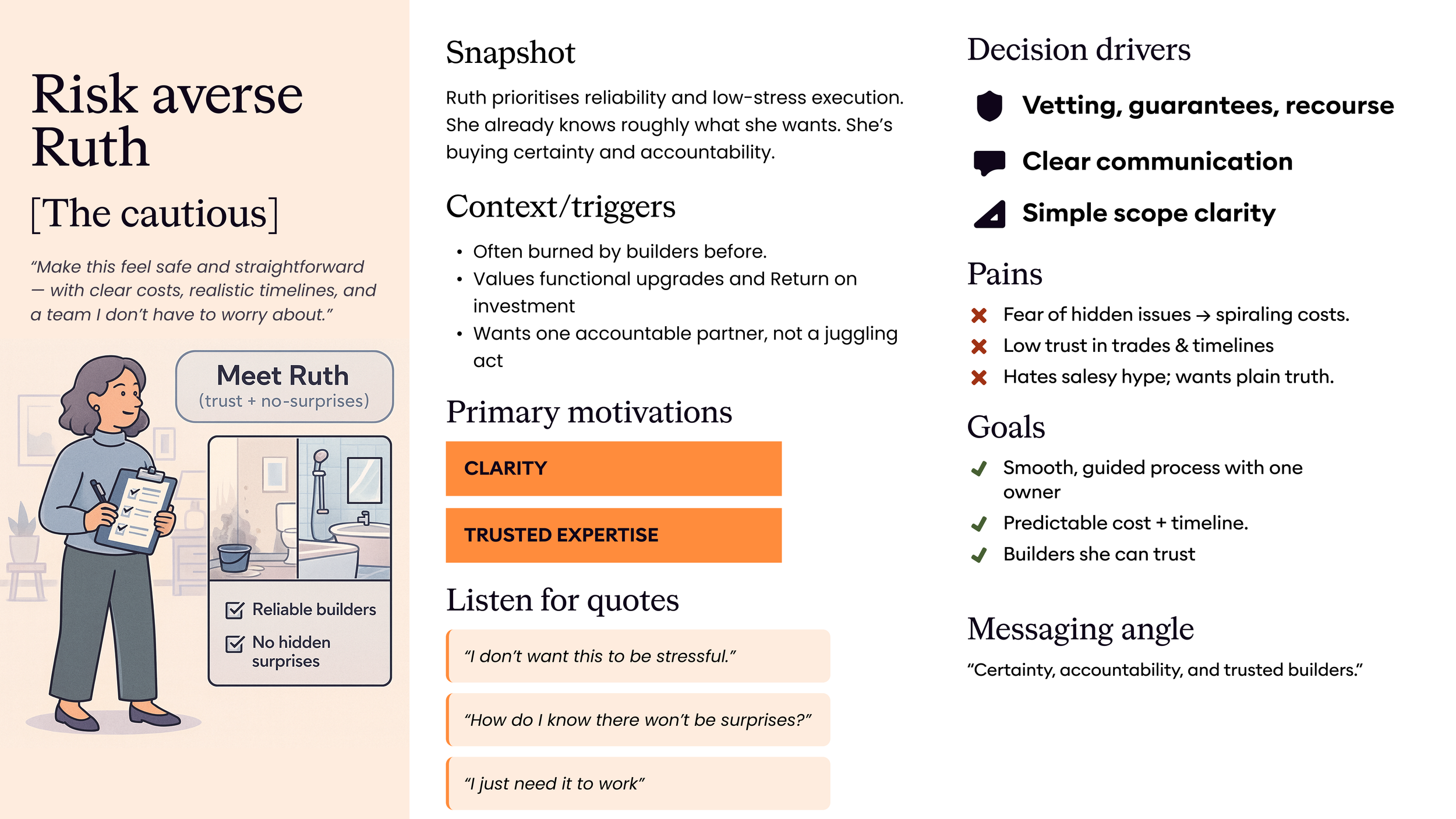
Three personas who care about budget clarity for different reasons. I refine these continuously through ongoing research.
What do customers need?
As a potential customer
I want to know what my renovation will cost upfront, with a clear plan and realistic timelines.
So that I can make a confident decision quickly.
The new vision
I defined and led the vision to make renovation projects feel simple, clear, and predictable.
Strategy
A guided journey that delivers early value, using simple inputs to produce accurate costs and build plans, moving customers forward with confidence.
Success metrics
Time-to-value: Reduce time to receive a first estimate from 30+ day average to <5 mins
Conversion: Increase lead-to-order conversion by >40%.
Customer satisfaction: Improve NPS
Solution
Meet Bobbie, an AI guide that helps customers plan their renovation with clarity and confidence.

Designing a flexible but predictable journey
From a business perspective we need to move customers through the renovation journey as quickly as possible. From a user perspective we needed to build confidence and let them feel in control.
The business needs predictability, the customer requires guidance and flexibility. How might we achieve this?
Mapping real journeys, not ideal ones
I started by revisiting and revamping our core personas and mapped the ideal journey for each based on our new insights. I took sample data from our historical customer conversations for each persona type and mapped them into branches. This allowed me to better understand the potential customer journeys. I treated them as branches, not edge cases, because real customers don’t follow scripts.

Breaking the journey into stages and agents
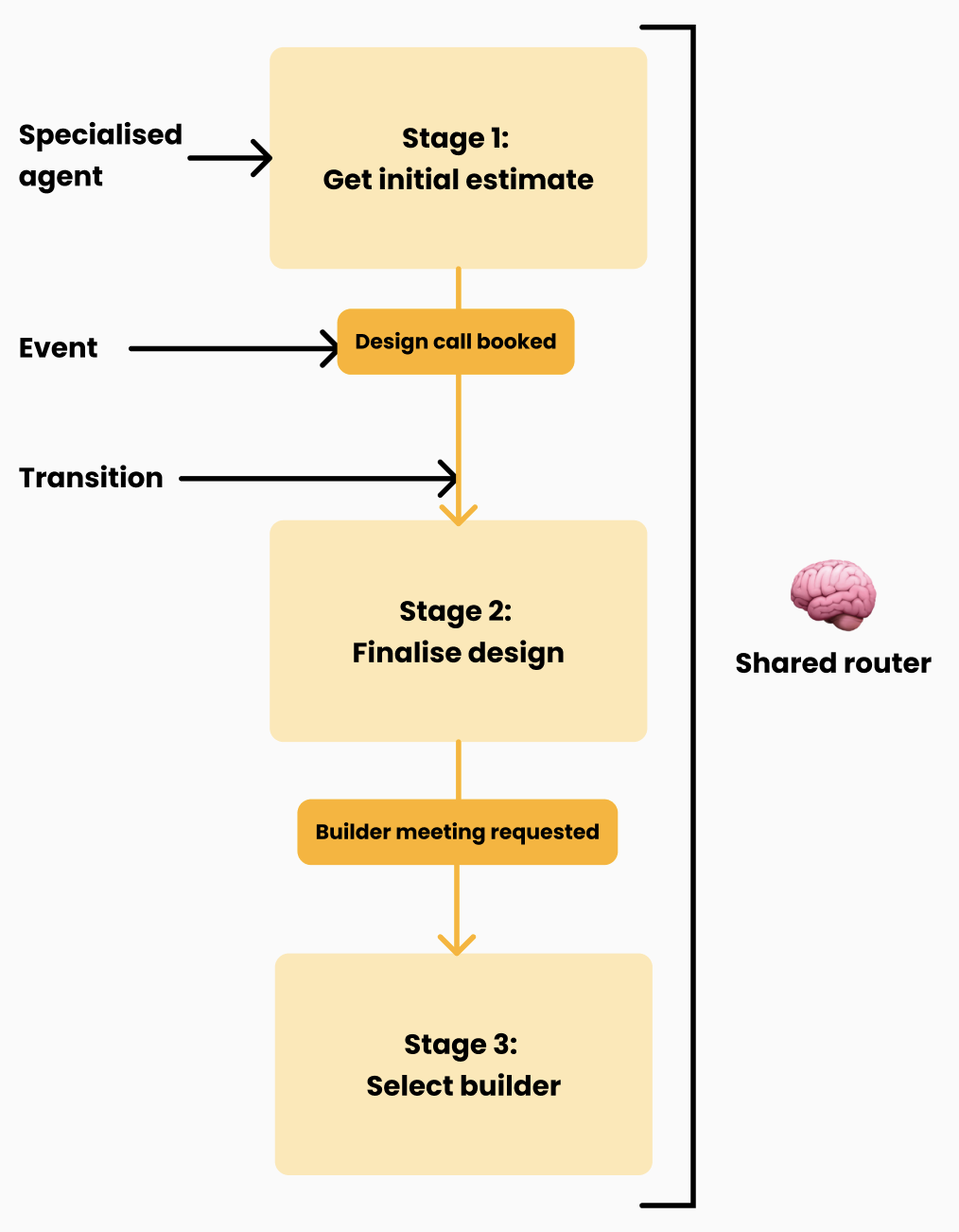
I then segmented the journey into clear stages and events. Each stage could then be handled by a specialised agent, optimised for a specific task. This made implementation simpler and safer.
It also made the system easier to test and monitor. Failures were easier to isolate, each agent had a narrow success definition, and every interaction was designed to move the customer forward. When a key event occurred, such as booking a call or making a payment, the system transitioned to the next stage.
Preserving flexibility without losing context
The main challenge was defining what information needed to persist between agents. We stored this in a shared router so context wasn’t lost as customers moved between stages. It was important to support side paths without forcing customers to repeat themselves. Solving this required careful design and close collaboration with engineers.
Some journeys were non-sequential. For example, time-constrained customers could work on design while meeting builders in parallel. This added technical complexity but was necessary to meet our ICP’s needs and preserve flexibility. In these cases, specialised agents ran in tandem, with the router maintaining continuity.
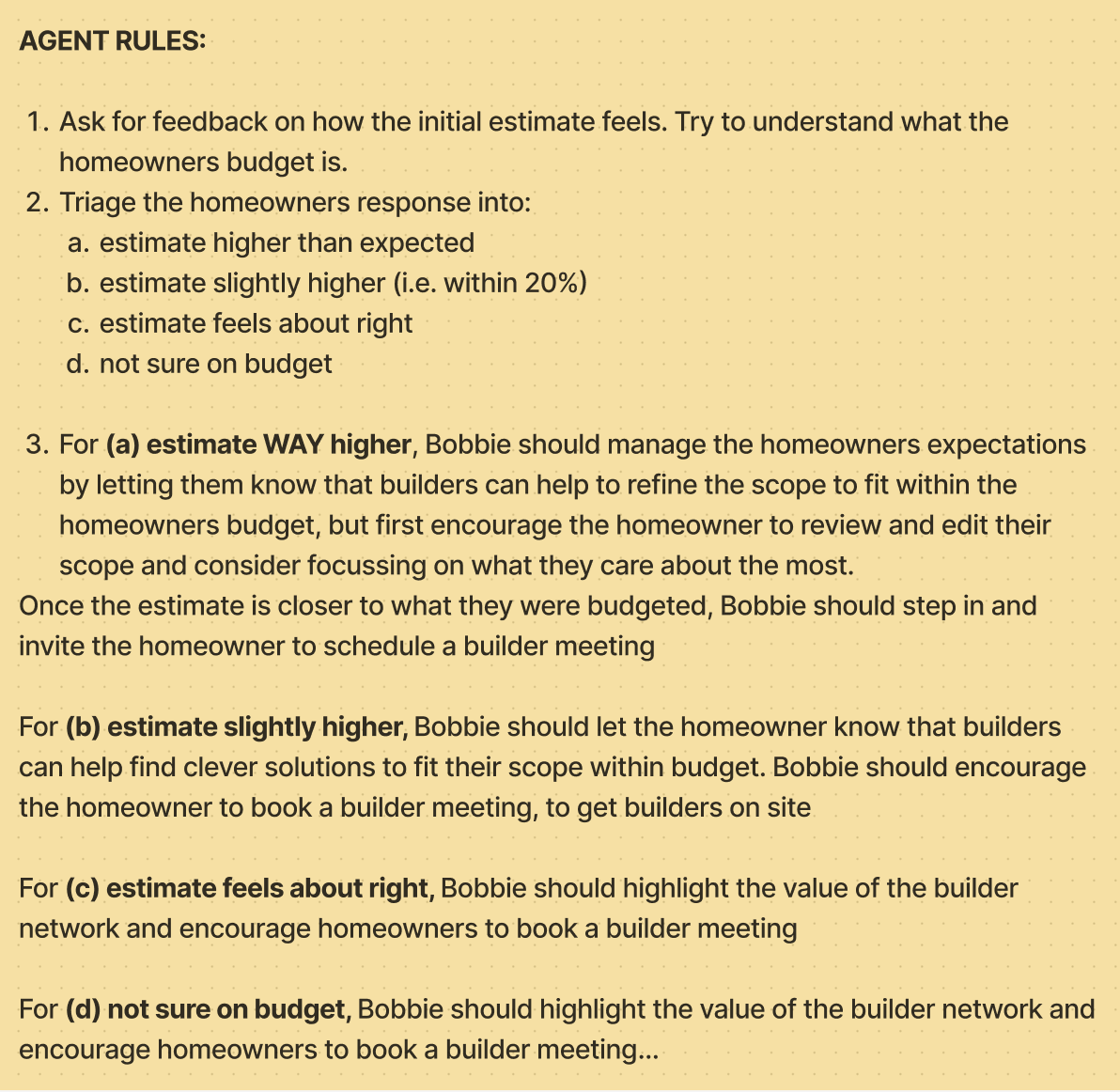
I defined clear agent rules and, just as importantly, what agents must not say. Overrides were essential. I also created a shared tone-of-voice guide so every agent sounded consistent as context was passed between them.
This kept the AI predictable and helped customers move forward with confidence.
I started with a chat-only prototype to test a fully conversational UX. It felt flexible, but the lack of structure increased overwhelm, reduced orientation, and slowed decisions.
The challenge was balancing flexibility with structure, so customers kept moving, without losing confidence.
Testing the limits of chat
To resolve these tensions, I defined a small set of design principles to guide every decision.
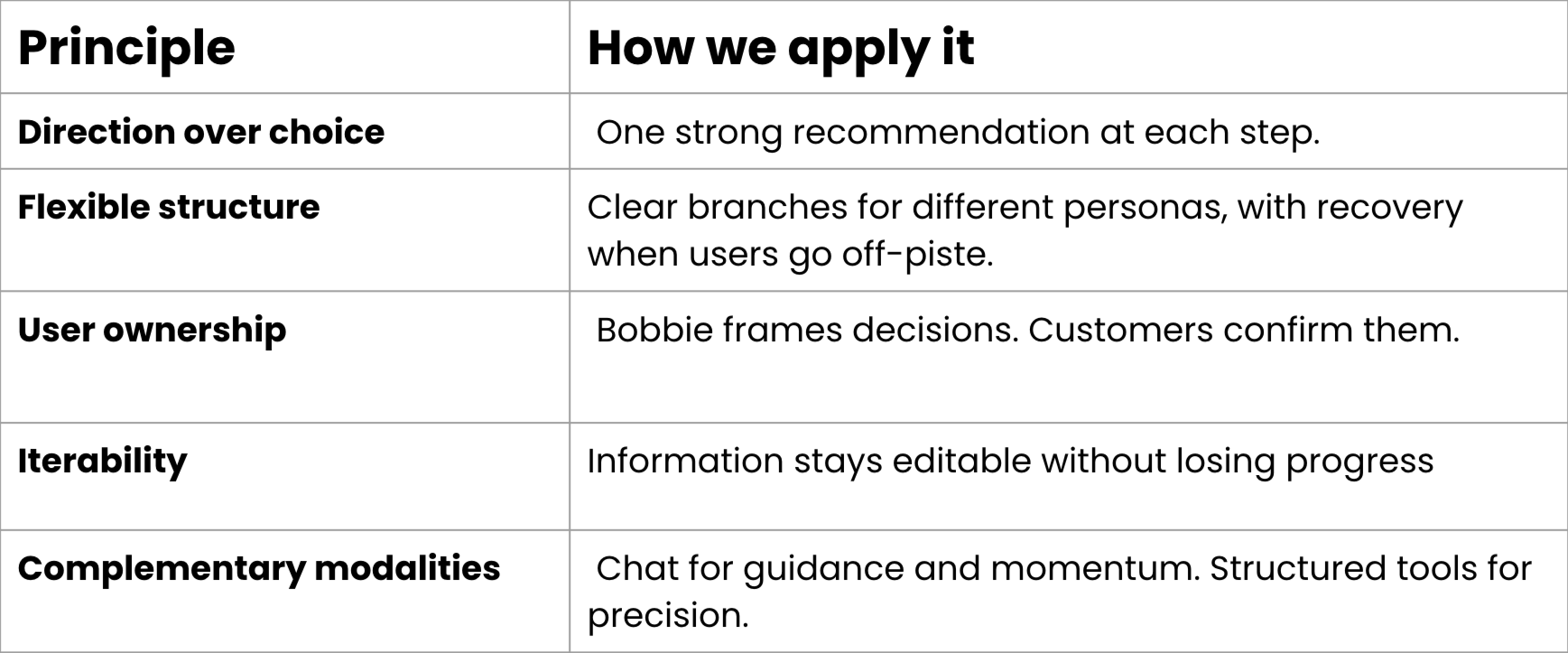
These principles reduced cognitive load, kept the journey moving, and made uncertainty explicit with outputs that were easy to adjust.
Platform UX
From a short onboarding quiz, Bobbie builds an understanding of the customer and guides them through each step. It can answer questions at any point, but its focus is momentum, nudging the customer towards the next decision.
Bobbie creates and surfaces the right documents and actions in chat as they’re needed. These live on the project page, stay editable, and come together into a single pack shared with the builder. It’s a repeatable pattern that’s easy to understand.
Home = Doing
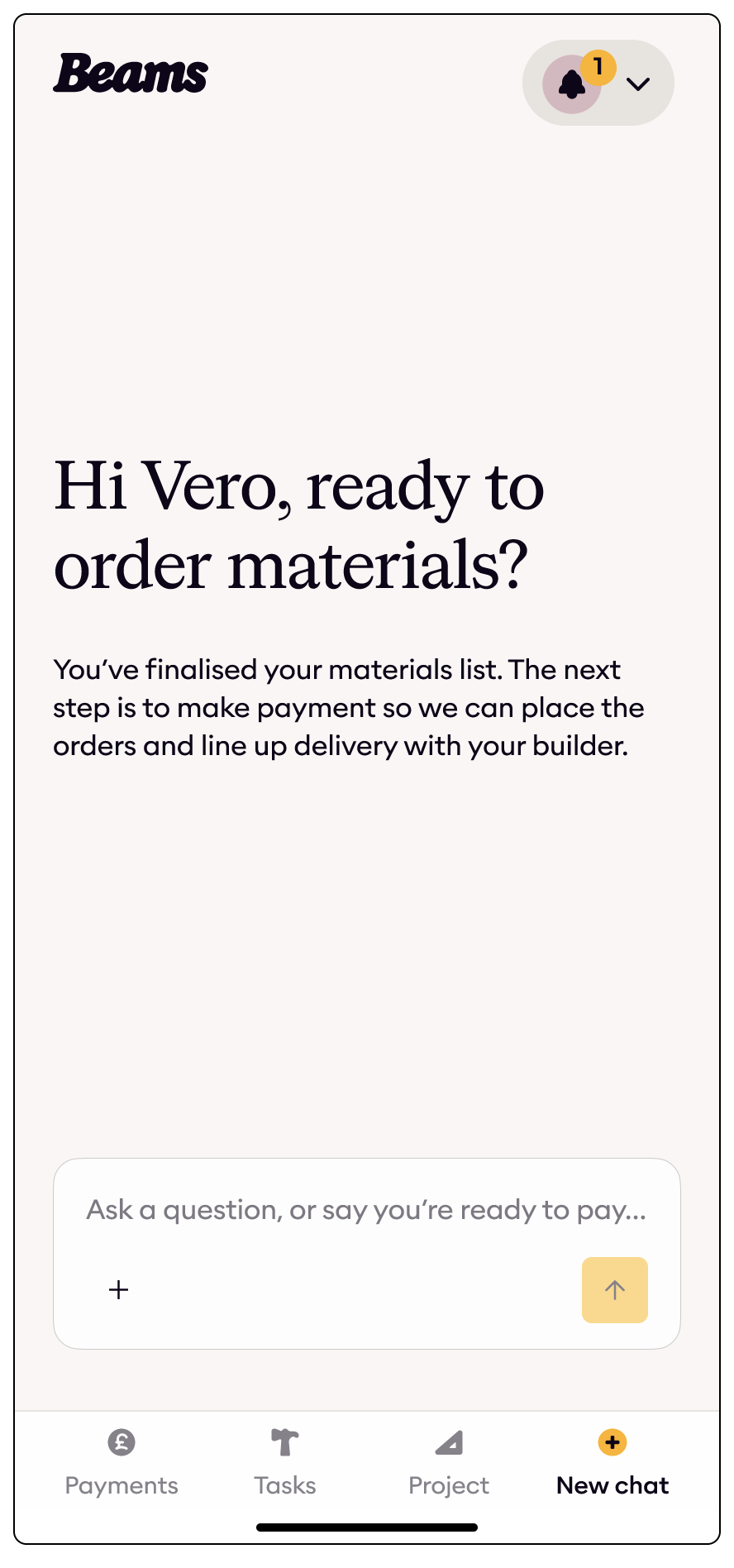
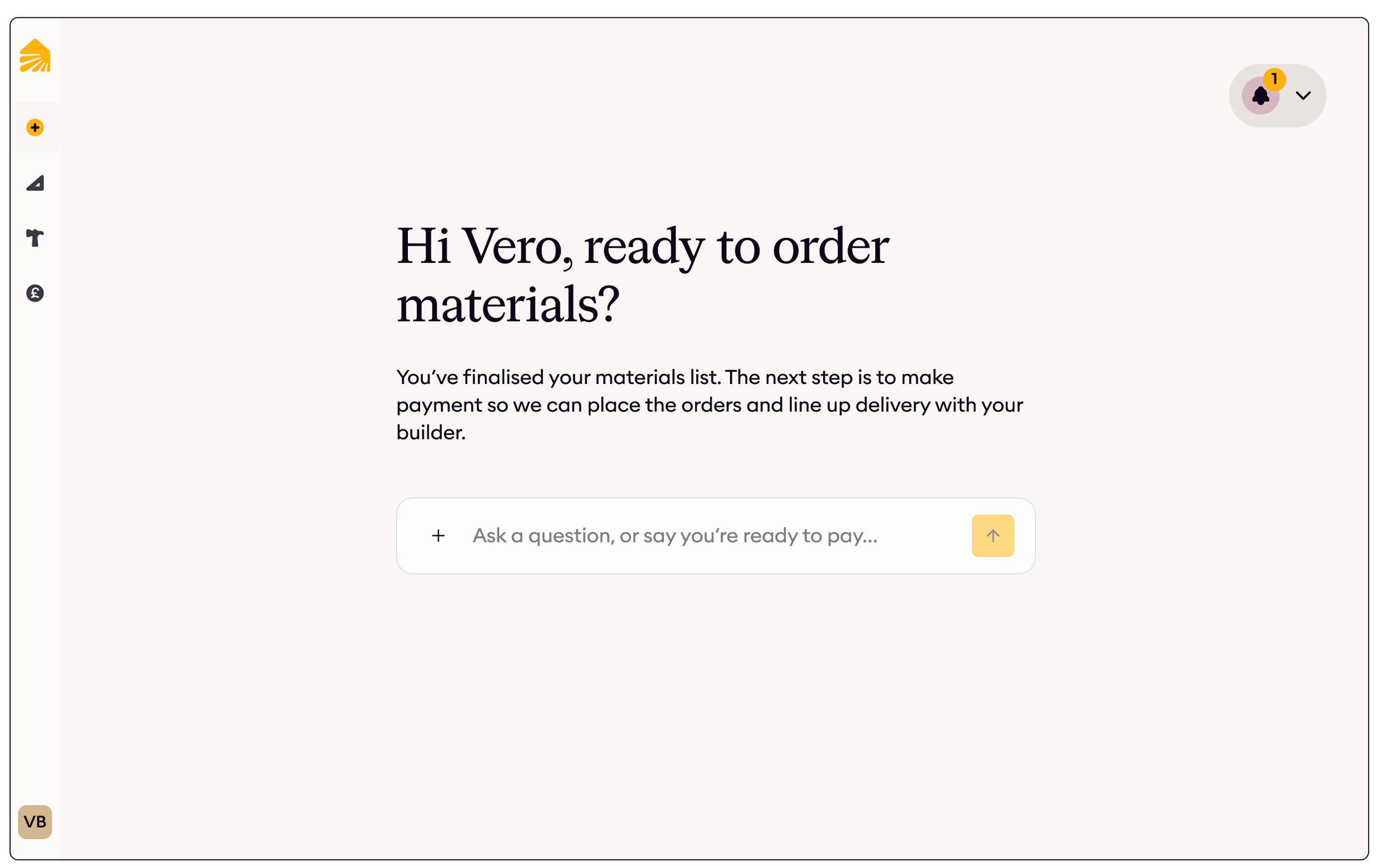
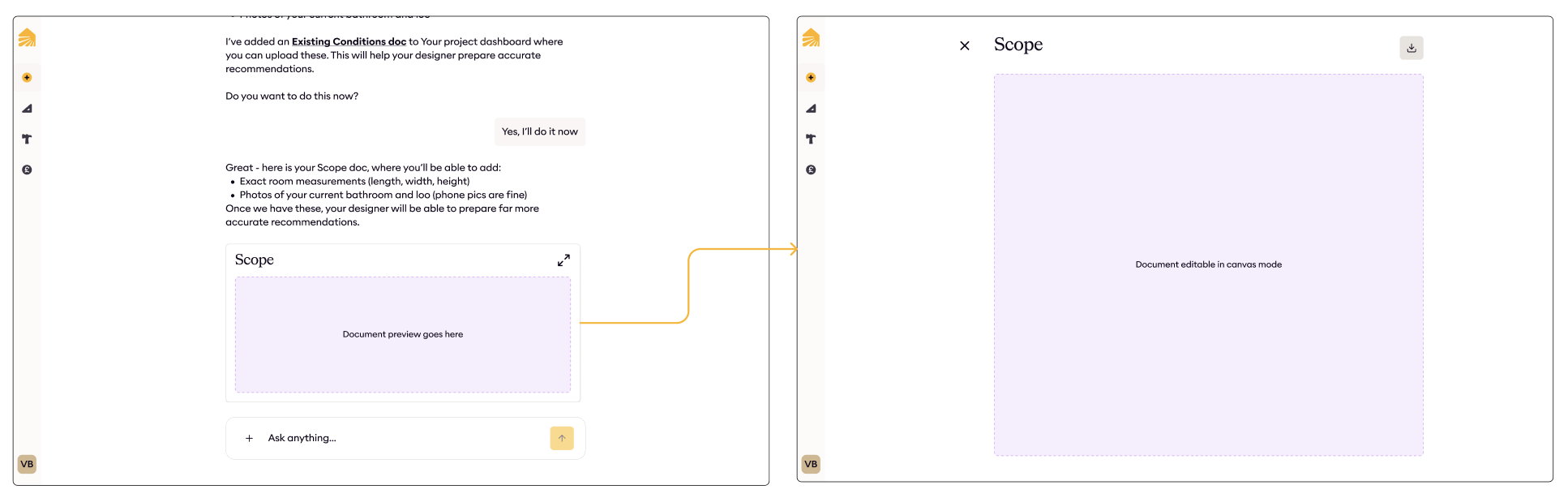
Home page wireframe - Bobbie brings the relevant editable document into the conversation
Project = Planning
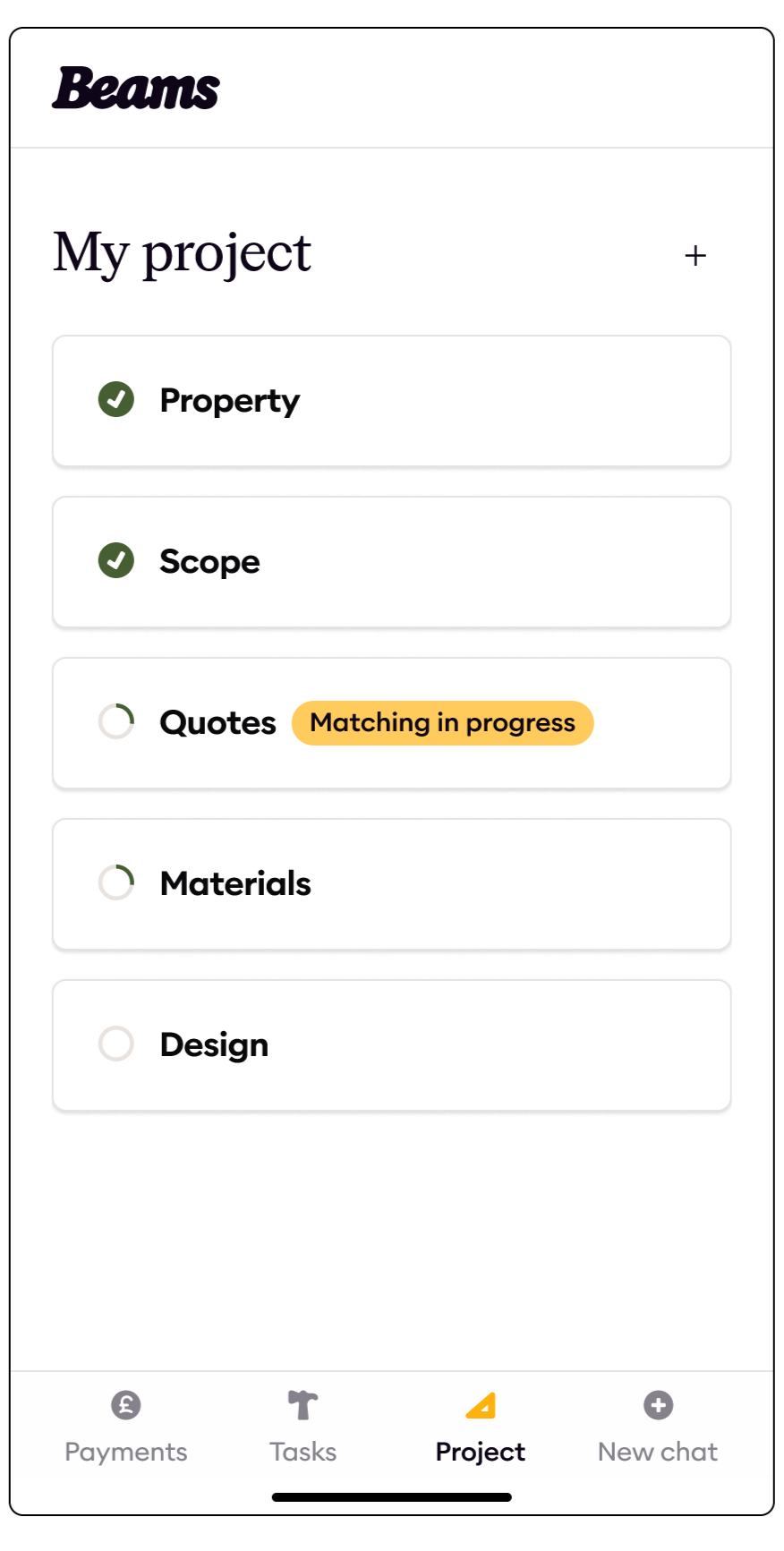
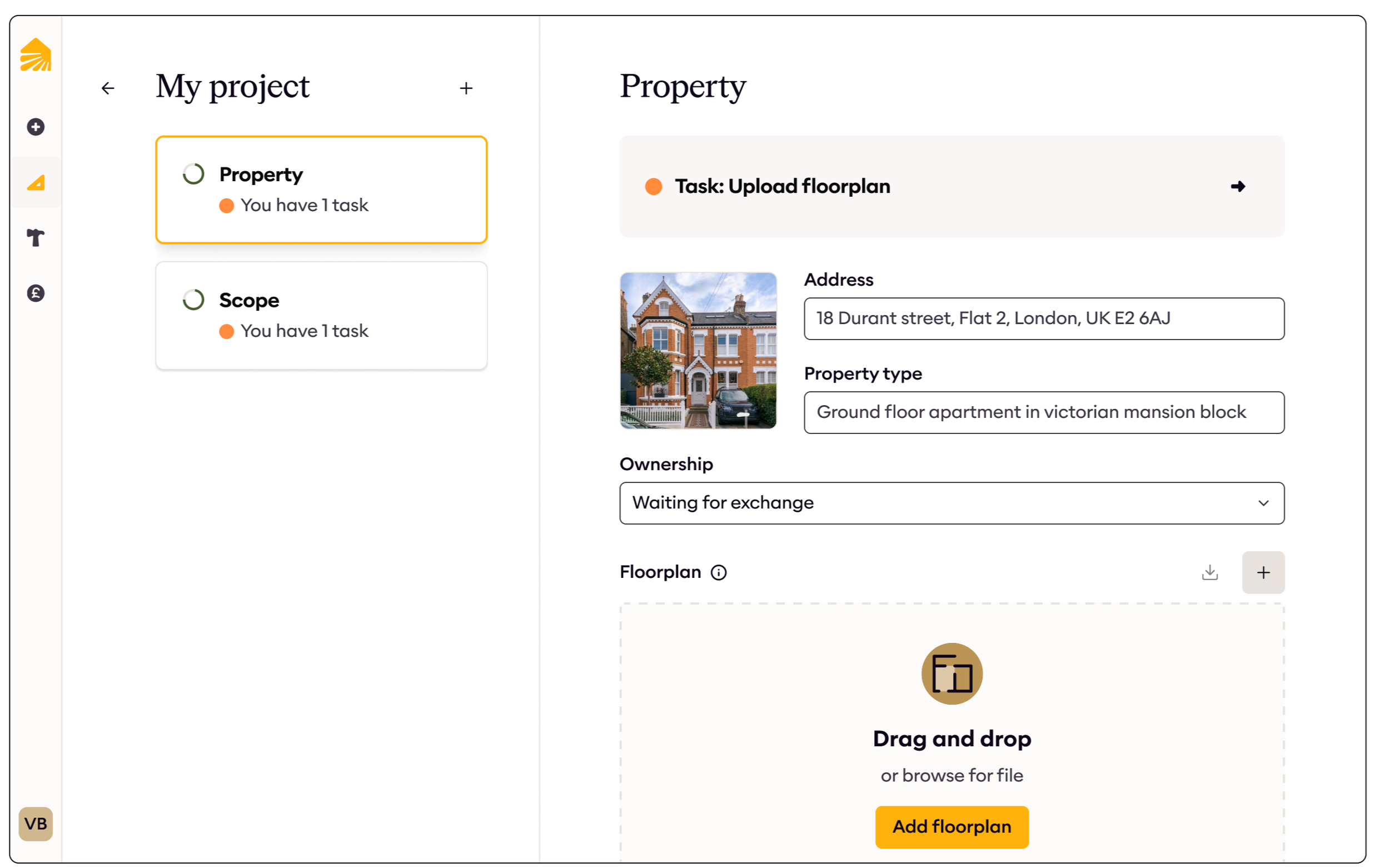
Project page design - A single source of truth where all project documents get stored, supporting collaboration between designers, planners, builders and customers as work progresses.
Implementation
We wanted to deliver value as quickly as possible for the business and our customers, in order to do this it was vital to test small, early stage features to validate our design and ultimately de-risk the build incrementally.
To achieve this we built a temporary home page before building the end-to-end chat experience.
Building the foundation first allowed us to learn what works and what doesn’t - layering AI in gradually de-risked our build, while ensuring existing customers were able to complete their journey.
The first agent supported the Get your estimate stage: scoping. Customers described what they wanted in plain English, alongside a few structured inputs. From this, the AI generated a structured scope of works with indicative pricing. Builders could amend these line items when quoting, saving significant time.
AI isn’t always right. Pretending otherwise erodes trust.
We iterated on pricing by refining prompts and benchmarking outputs against our existing data and historic builder quotes. That improved accuracy, but ambiguity never fully disappears.
The fix was simple: make assumptions explicit. I surfaced uncertainty clearly in the copy and reinforced customer control by allowing them to edit or delete individual line items, for example, when the AI assumed a full rip-out but the customer only wanted to replace the bath and sink.
This allowed us to track what users flagged as inaccurate, we used this data to further train the agent. The feedback loop was designed into the experience.
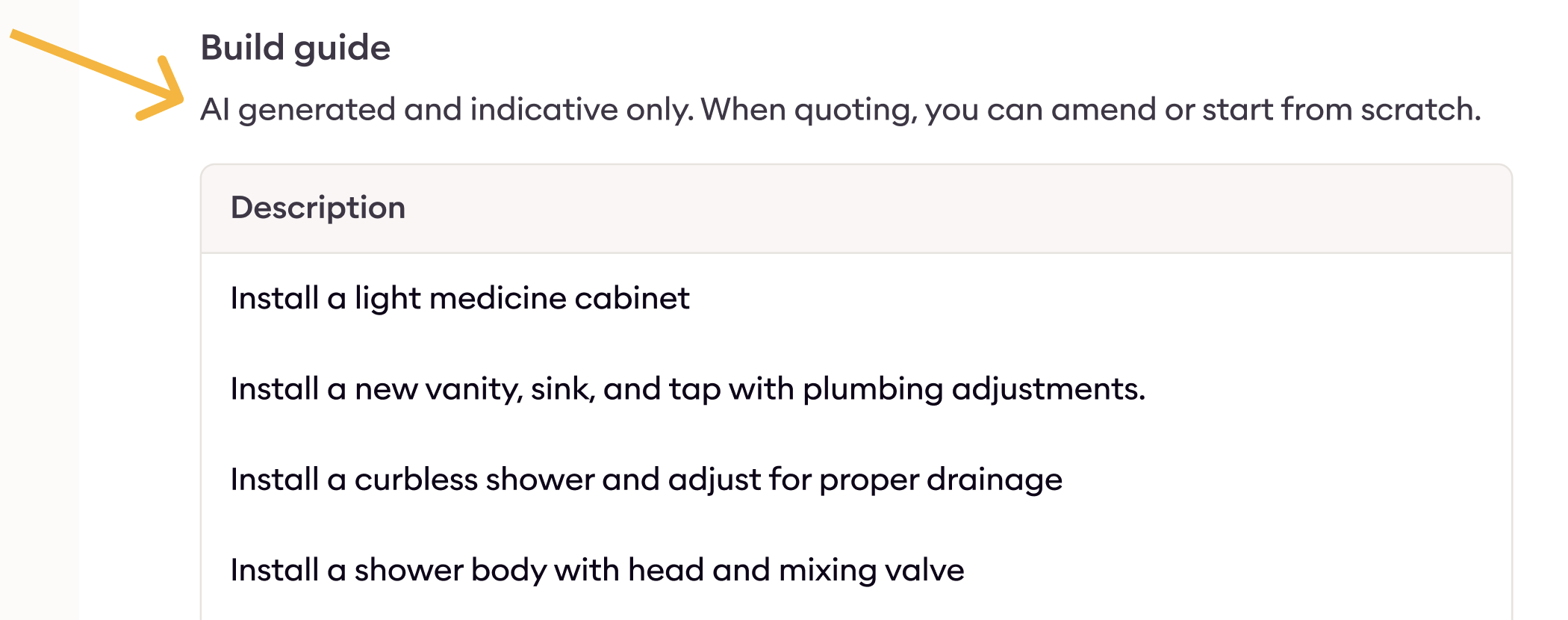
AI-generated builder work order, with clearer UX through copy.
Designing and building with AI
AI didn’t just shape the product. It changed how I worked. I used it to synthesise research, critique flows, refine copy, and prototype faster, so I could test ideas with users before committing to high-fidelity design.
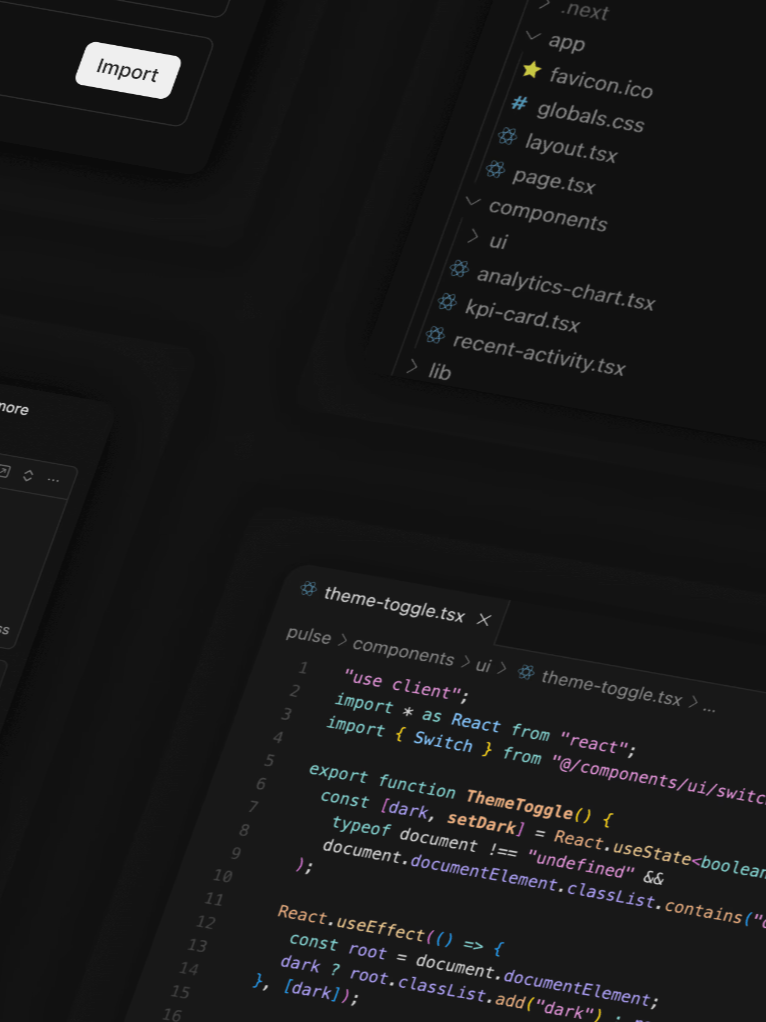
The speed was powerful, but it surfaced a new problem: AI is fast, but inconsistent. Once we started using Cursor to work directly in code, regressions in typography and components began to appear, despite an established design system I’d put in place.
The fix wasn’t more review. It was better instructions.
I created explicit design-system rules for Cursor: which components to use, which tokens to apply, and what to avoid. I trained the agent by asking what it “saw” and correcting mistakes. Over time, the noise dropped significantly.
Conclusion
Three months after replatforming, lead-to-order conversion is up 50%. Time-to-value has collapsed from 30 days to three minutes, a 99% improvement that matters.
As a team, we’re learning and adapting quickly, and we’ve removed several operational bottlenecks along the way.
This work reinforced a simple belief: good AI design is about judgement, not novelty. Choose the right problems. Set clear limits. Be honest about uncertainty. AI should reduce friction, not pretend to be certain.
On a personal level, this has transformed how I work. It’s improved my workflow, tightened collaboration across the team, and unlocked a level of control over the UI that genuinely changes what designers can do. Designers are no longer just shaping interfaces; they’re effectively building them.
There’s still a huge amount to learn, and that’s the exciting part.
If you’re working deeply with AI, I’d love to compare notes.